


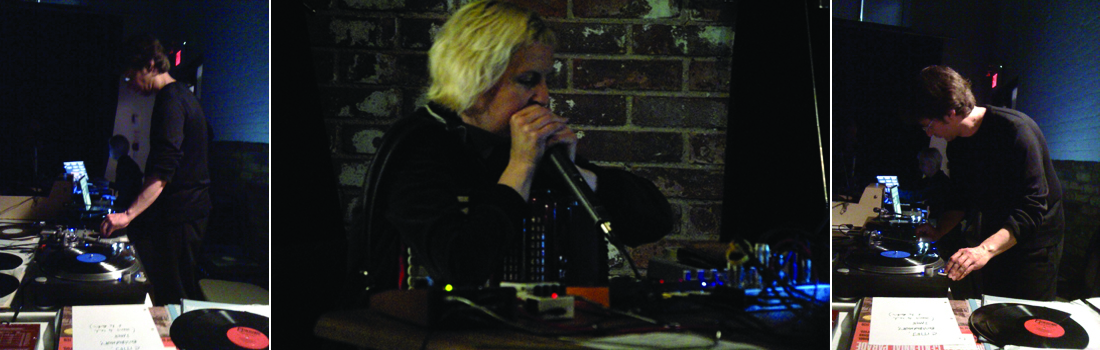
Performances
Art's Birthday Sound Art Jam
January 17, 2026 at 1 pm
In-Person at NAISA North Media Arts Centre, 313 Highway 124, South River, Ontario, Canada
FREE
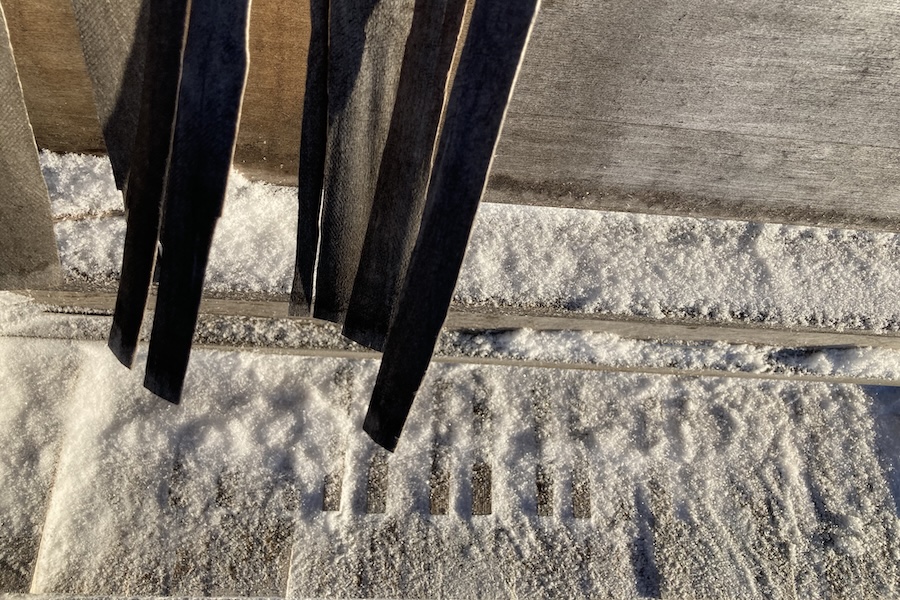
Come celebrate Art's Birthday with NAISA by participating in an indoor and outdoor sound art jam. Bring something that makes sound, or something you can use to strum or make percussive sounds on the Decomposing Piano. All experience levels welcome. The jam will be shared on the Art's Birthday Mesh Network, connecting with Art's Birthday celebrations happening around the world. And yes, there will be cake!
Art’s Birthday is an annual exchange art event celebrated internationally by the arts community. Happy 1,000,063rd Birthday, Art!
January 17, 2026 at 1 pm
In-Person at NAISA North Media Arts Centre, 313 Highway 124, South River, Ontario, Canada
FREE
Come celebrate Art's Birthday with NAISA by participating in an indoor and outdoor sound art jam. Bring something that makes sound, or something you can use to strum or make percussive sounds on the Decomposing Piano. All experience levels welcome. The jam will be shared on the Art's Birthday Mesh Network, connecting with Art's Birthday celebrations happening around the world. And yes, there will be cake!
Art’s Birthday is an annual exchange art event celebrated internationally by the arts community. Happy 1,000,063rd Birthday, Art!

Sandpaper Hammock
In-Person and Online Radio Art Performance
By Aliyah Aziz
February 21, 2026 at 7 pm
In-Person at NAISA North Media Arts Centre, 313 Highway 124, South River, Ontario, Canada.
Online audiences register in advance for access.
Tickets $15
Aliyah Aziz performs her work Sandpaper Hammock in-person and online at 7 pm on Feb 21 at NAISA. Aziz will be wearing custom-made gloves that will draw out electromagnetic sounds from old CRT monitors, a camera, and other electric signals. She mixes those sounds with spoken word, electronic pedals and loopers. See the artist's article Everything Has a Voice for more detail about the performance.
In-Person and Online Radio Art Performance
By Aliyah Aziz
February 21, 2026 at 7 pm
In-Person at NAISA North Media Arts Centre, 313 Highway 124, South River, Ontario, Canada.
Online audiences register in advance for access.
Tickets $15
Aliyah Aziz performs her work Sandpaper Hammock in-person and online at 7 pm on Feb 21 at NAISA. Aziz will be wearing custom-made gloves that will draw out electromagnetic sounds from old CRT monitors, a camera, and other electric signals. She mixes those sounds with spoken word, electronic pedals and loopers. See the artist's article Everything Has a Voice for more detail about the performance.
Installations
Material Transmissions
By Anju Singh
January 8 to March 30, 2026. Open 10 am to 4 pm Thursday to Monday
NAISA North Media Arts Centre, 313 Highway 124, South River, Ontario.
Admission by Donation
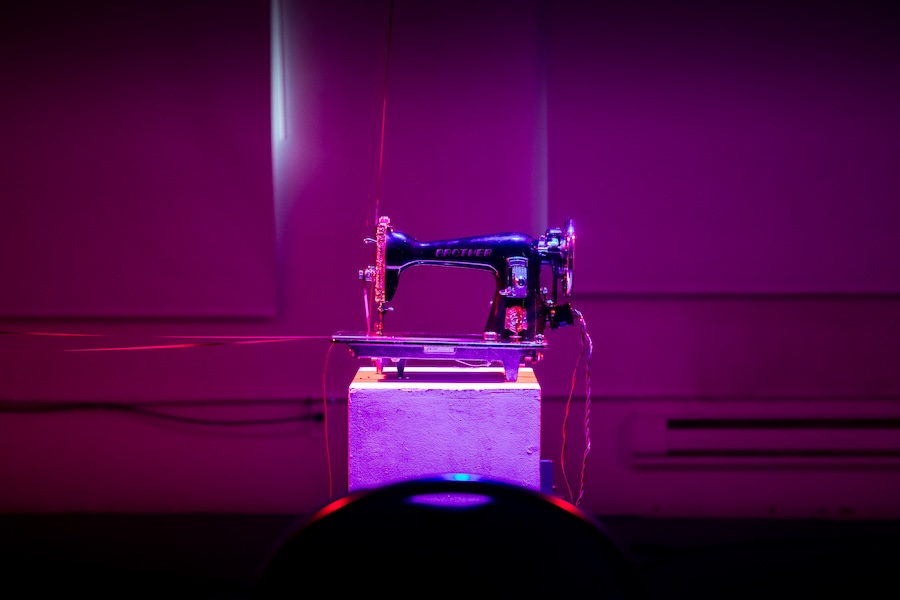
Material Transmissions is a machine-based sound sculpture that uses innate machine sounds and external sound sources infused back into the machine as sonic artifacts that are transmitted through transducers projected into a selection of found or hand made textile and industrial materials. This project is part of the MECHANICAL HYMNS project, a series of works developed by Anju Singh that explores the relationship between machines, industrial materials, and mechanical elements with sound, noise, and transmitted audio.
The artist's interest in these sounds began with her experience hearing hymns in temples as forms of music and then feeling there was a strong relationship between those drone sounds and machine noise, often droning and hypnotic in nature. She was curious about the acceptance of hymn-based drones while machine drones were considered purely noise, and this led her to better understand some underlying reasons for her aesthetic preference for noise-based textures that led her to become a noise artist. The MECHANICAL HYMNS series interrogates assumptions about the nature of noise, machine sounds, music, and mechanical silence.
By Anju Singh
January 8 to March 30, 2026. Open 10 am to 4 pm Thursday to Monday
NAISA North Media Arts Centre, 313 Highway 124, South River, Ontario.
Admission by Donation
Material Transmissions is a machine-based sound sculpture that uses innate machine sounds and external sound sources infused back into the machine as sonic artifacts that are transmitted through transducers projected into a selection of found or hand made textile and industrial materials. This project is part of the MECHANICAL HYMNS project, a series of works developed by Anju Singh that explores the relationship between machines, industrial materials, and mechanical elements with sound, noise, and transmitted audio.
The artist's interest in these sounds began with her experience hearing hymns in temples as forms of music and then feeling there was a strong relationship between those drone sounds and machine noise, often droning and hypnotic in nature. She was curious about the acceptance of hymn-based drones while machine drones were considered purely noise, and this led her to better understand some underlying reasons for her aesthetic preference for noise-based textures that led her to become a noise artist. The MECHANICAL HYMNS series interrogates assumptions about the nature of noise, machine sounds, music, and mechanical silence.
Broadcasts

Art's Birthday Mesh Broadcasts
Enjoy Streams on the Art's Birthday Mesh.
FREE, Full 2026 Schedule Available Here
Check in to the Art's Birthday mesh network throughout the January 17th weekend for performances, videos, photo collages, web art and more happening from around the World. Art’s Birthday is an annual exchange art event celebrated internationally by the arts community. Happy 1,000,063rd Birthday, Art!
Enjoy Streams on the Art's Birthday Mesh.
FREE, Full 2026 Schedule Available Here
Check in to the Art's Birthday mesh network throughout the January 17th weekend for performances, videos, photo collages, web art and more happening from around the World. Art’s Birthday is an annual exchange art event celebrated internationally by the arts community. Happy 1,000,063rd Birthday, Art!

Deep Wireless 20 Compilation Album
Click Here to Listen to this and other Deep Wireless Albums
The 20th edition of the Deep Wireless Compilation is produced by New Adventures in Sound Art (NAISA) for the 2026 edition of the annual Deep Wireless Festival of Radio & Transmission Art. The album includes sound art and radio art works that respond to the theme Sound Culture created by Cristian Gabriele Argento, Haley Sheppard, Linda Rae Dornan, Landforms (Gillis Van Der Wee and Lotte Nijsten) and Marco Neri. The artists draw from personal stories, memories and reflections in order to offer in their works alternative perspectives on how a sound environment or social context might be perceived or represented in art.
Deep Wireless 20 Credits for New Adventures in Sound Art (NAISA):
Artistic Director: Darren Copeland
Executive Director: Nadene Thériault-Copeland
Image Illustration: Prashant Miranda
Click Here to Listen to this and other Deep Wireless Albums
The 20th edition of the Deep Wireless Compilation is produced by New Adventures in Sound Art (NAISA) for the 2026 edition of the annual Deep Wireless Festival of Radio & Transmission Art. The album includes sound art and radio art works that respond to the theme Sound Culture created by Cristian Gabriele Argento, Haley Sheppard, Linda Rae Dornan, Landforms (Gillis Van Der Wee and Lotte Nijsten) and Marco Neri. The artists draw from personal stories, memories and reflections in order to offer in their works alternative perspectives on how a sound environment or social context might be perceived or represented in art.
Deep Wireless 20 Credits for New Adventures in Sound Art (NAISA):
Artistic Director: Darren Copeland
Executive Director: Nadene Thériault-Copeland
Image Illustration: Prashant Miranda
Program:
I. Diviso in due by Cristian Gabriele Argento
Diviso in due by Cristian Gabriele Argento explores a panic attack’s inner landscape, blending natural sounds from a botanical garden with emotional turbulence. The piece invites introspection, revealing fragility and resilience. The garden becomes a sonic sanctuary—a bridge between inner chaos and healing—reminding us that even in despair, renewal and peace remain possible.
Diviso in due by Cristian Gabriele Argento explores a panic attack’s inner landscape, blending natural sounds from a botanical garden with emotional turbulence. The piece invites introspection, revealing fragility and resilience. The garden becomes a sonic sanctuary—a bridge between inner chaos and healing—reminding us that even in despair, renewal and peace remain possible.
II. Transcription: LoveLanguageLoss by Linda Rae Dornan
Transcription: LoveLanguageLoss by Linda Rae Dornan is an audio art piece about dementia and caregiving recorded over many years as I cared for my partner, John Asimakos. The journal I kept was too emotionally difficult to read so I eventually transcribed it backwards to alleviate my own response. Transcription uses this reversed journal, cutup techniques and constant repetition collaged with John’s own voice as he tried to communicate. Constant repetition references the incomprehension and deterioration of language evident within the gradual decline of dementia patients. The audio piece attempts to share an interior space of intensity and tenderness within the isolated world of dementia and caregiving.
Transcription: LoveLanguageLoss by Linda Rae Dornan is an audio art piece about dementia and caregiving recorded over many years as I cared for my partner, John Asimakos. The journal I kept was too emotionally difficult to read so I eventually transcribed it backwards to alleviate my own response. Transcription uses this reversed journal, cutup techniques and constant repetition collaged with John’s own voice as he tried to communicate. Constant repetition references the incomprehension and deterioration of language evident within the gradual decline of dementia patients. The audio piece attempts to share an interior space of intensity and tenderness within the isolated world of dementia and caregiving.
III. “¿Aún recuerdas mi voz?” by Marco Neri
“¿Aún recuerdas mi voz?” by Marco Neri is a computer-assisted composition based on a Cardenche song from Durango, Mexico—a melancholic tradition named after a cactus whose spines hurt most when being removed. The piece reflects on vanishing cultures, evoking ancestral voices that echo through memory and digital transformation.
“¿Aún recuerdas mi voz?” by Marco Neri is a computer-assisted composition based on a Cardenche song from Durango, Mexico—a melancholic tradition named after a cactus whose spines hurt most when being removed. The piece reflects on vanishing cultures, evoking ancestral voices that echo through memory and digital transformation.
IV. The Loud Mechanical Hum that Seems to Be Getting More and More Frequent by Haley Sheppard
This work follows the Reddit threads of downtown Kitchener residents, perplexed by the mechanical and mythical hums of the city. By listening, one can contend with the hums as sonic traces of capitalism, settler colonialism, and ecological destruction. What might it mean to interrupt or counter these mostly unnoticed, yet ongoing signals of occupation, with the hum of a singular human body?
This work follows the Reddit threads of downtown Kitchener residents, perplexed by the mechanical and mythical hums of the city. By listening, one can contend with the hums as sonic traces of capitalism, settler colonialism, and ecological destruction. What might it mean to interrupt or counter these mostly unnoticed, yet ongoing signals of occupation, with the hum of a singular human body?
V. Liquid Polyphonies by Landforms (Gillis Van Der Wee and Lotte Nijste)
Liquid Polyphonies by Landforms (Gillis Van Der Wee and Lotte Nijste) is a sound composition that invites the listener on an acoustic journey throughout the polyphonic soundscape of the North Sea. By weaving together anthropophonic, biophonic, and technophonic sounds, and by searching for sonic analogies between the human and non-human through a combination of voice recordings, foley recordings, and field recordings, Lotte and Gillis create an electro-acoustic composition that emphasizes the interconnectedness between human and non-human entities at sea. Creating this piece, Lotte and Gillis reflected on interspecies listening, and their own position in the field as recordists: what can sound tell us about our relationship to the sea? And what role are we taking on as field recordists? Liquid Polyphonies was created during the residency program of Phonurgia Nova and GMEM Marseille.
Liquid Polyphonies by Landforms (Gillis Van Der Wee and Lotte Nijste) is a sound composition that invites the listener on an acoustic journey throughout the polyphonic soundscape of the North Sea. By weaving together anthropophonic, biophonic, and technophonic sounds, and by searching for sonic analogies between the human and non-human through a combination of voice recordings, foley recordings, and field recordings, Lotte and Gillis create an electro-acoustic composition that emphasizes the interconnectedness between human and non-human entities at sea. Creating this piece, Lotte and Gillis reflected on interspecies listening, and their own position in the field as recordists: what can sound tell us about our relationship to the sea? And what role are we taking on as field recordists? Liquid Polyphonies was created during the residency program of Phonurgia Nova and GMEM Marseille.
Workshops
Art's Birthday Sound Art Jam
January 17, 2026 at 1 pm
In-Person at NAISA North Media Arts Centre, 313 Highway 124, South River, Ontario, Canada
FREE
Come celebrate Art's Birthday with NAISA by participating in an indoor and outdoor sound art jam. Bring something that makes sound, or something you can use to strum or make percussive sounds on the Decomposing Piano. All experience levels welcome. The jam will be shared on the Art's Birthday Mesh Network, connecting with Art's Birthday celebrations happening around the world. And yes, there will be cake!
Art’s Birthday is an annual exchange art event celebrated internationally by the arts community. Happy 1,000,063rd Birthday, Art!
January 17, 2026 at 1 pm
In-Person at NAISA North Media Arts Centre, 313 Highway 124, South River, Ontario, Canada
FREE
Come celebrate Art's Birthday with NAISA by participating in an indoor and outdoor sound art jam. Bring something that makes sound, or something you can use to strum or make percussive sounds on the Decomposing Piano. All experience levels welcome. The jam will be shared on the Art's Birthday Mesh Network, connecting with Art's Birthday celebrations happening around the world. And yes, there will be cake!
Art’s Birthday is an annual exchange art event celebrated internationally by the arts community. Happy 1,000,063rd Birthday, Art!
Stories Through Sound - Winter Workshop Intensive
February 6 to 8, 2026
Warbler’s Roost, 3785D Eagle Lake Road, South River, Ontario
$339 with 2 nights accommodation and $215 with no accommodation.
February 6 to 8, 2026
Warbler’s Roost, 3785D Eagle Lake Road, South River, Ontario
$339 with 2 nights accommodation and $215 with no accommodation.
Advance Registration Required
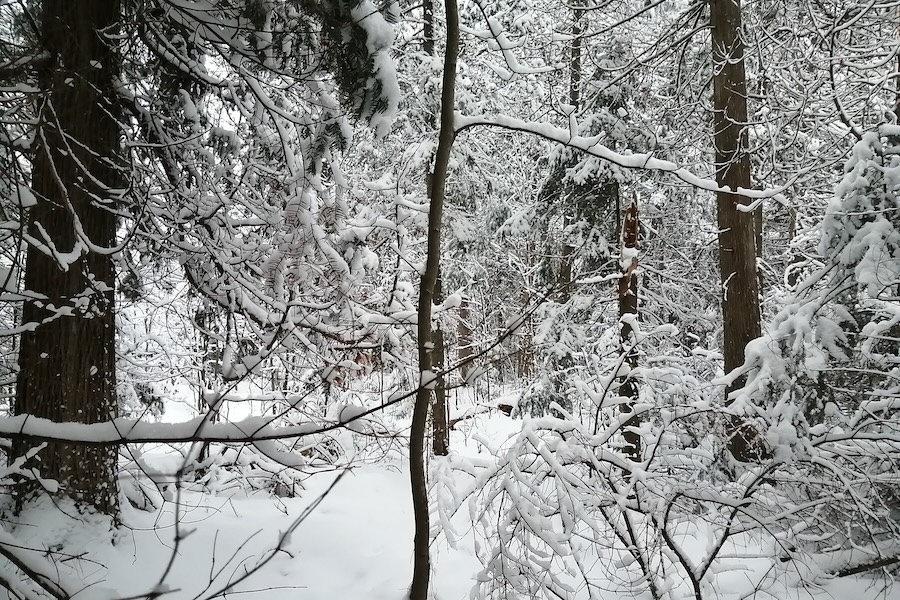
A winter workshop at Warbler’s Roost in the Almaguin Highlands exploring storytelling through sound rather than words. The workshop will combine practical recording and audio production/creation experience with a curated listening session of Radio Art works, in order to consider the evocative potential of sounds to convey stories without words.
Participants will record winter soundscapes on a 14 acre rural property in Northern Ontario, including using hydrophones to explore the latent sounds of a frozen lake. Through guided field recording, group listening, and discussion, we’ll explore sound as story: non-linear, place-based, and more-than-human narratives shaped by winter environments.
All levels of Experience are welcome. Participants should bring a laptop and headphones and winter clothing suitable to keep your whole body dry and warm in sub-zero temperatures. Hydrophones will be provided. Participants are encouraged to bring their own personal recording equipment. Recorders can be provided upon request.
Warbler’s Roost is located in the unorganized rural Township of Lount which is 22 KM west of the village of South River, Ontario, Canada and is in the same biosphere as Algonquin Park and equidistant between the cities of North Bay and Huntsville.
There are comfortable indoor accommodations at Warbler's Roost with kitchens and bathrooms that are shared among the guests. Breakfast is provided each day.
Limited Spots Available. Accommodation discounts available for those wanting to share a room with a friend or partner.
Schedule:
Friday Feb 6
3:00 to 4:00 pm - Arrival and unpacking
4:00 to 5:00 pm - Winter SOUNDwalk
7:00 to 8:00 pm - Listening Session #1 - Stories told through sounds
8:00 to 10:00 pm - Night Recording
Saturday Feb 7
8:00 to 9:00 - Breakfast provided
9:00 to 12:00 - Morning Recording
13:00 to 14:00 - Sound Editing Tutorial - Reaper Basic introduction
14:00 to 15:00 - Sound Editing Tutorial - Editing Hydrophone Recordings
15:00 to 17:00 - Individual work on Editing (individual assistance is available)
17:00 to 18:00 - Listening Session #2 - Recordings made by Participants
18:00 to ? - Personal Creation Time
Sunday Feb 8
9:00 to 10:00 - Breakfast provided
11:00 to 12:00 pm - Listening Session #3 - Short Compositions by participants
12:00 to 2:00 pm - Lunch and Departure
2:00 to 4:00 - Material Transmissions installation visit to NAISA North Media Arts Centre, 313 Highway 124, South River
A winter workshop at Warbler’s Roost in the Almaguin Highlands exploring storytelling through sound rather than words. The workshop will combine practical recording and audio production/creation experience with a curated listening session of Radio Art works, in order to consider the evocative potential of sounds to convey stories without words.
Participants will record winter soundscapes on a 14 acre rural property in Northern Ontario, including using hydrophones to explore the latent sounds of a frozen lake. Through guided field recording, group listening, and discussion, we’ll explore sound as story: non-linear, place-based, and more-than-human narratives shaped by winter environments.
All levels of Experience are welcome. Participants should bring a laptop and headphones and winter clothing suitable to keep your whole body dry and warm in sub-zero temperatures. Hydrophones will be provided. Participants are encouraged to bring their own personal recording equipment. Recorders can be provided upon request.
Warbler’s Roost is located in the unorganized rural Township of Lount which is 22 KM west of the village of South River, Ontario, Canada and is in the same biosphere as Algonquin Park and equidistant between the cities of North Bay and Huntsville.
There are comfortable indoor accommodations at Warbler's Roost with kitchens and bathrooms that are shared among the guests. Breakfast is provided each day.
Limited Spots Available. Accommodation discounts available for those wanting to share a room with a friend or partner.
Schedule:
Friday Feb 6
3:00 to 4:00 pm - Arrival and unpacking
4:00 to 5:00 pm - Winter SOUNDwalk
7:00 to 8:00 pm - Listening Session #1 - Stories told through sounds
8:00 to 10:00 pm - Night Recording
Saturday Feb 7
8:00 to 9:00 - Breakfast provided
9:00 to 12:00 - Morning Recording
13:00 to 14:00 - Sound Editing Tutorial - Reaper Basic introduction
14:00 to 15:00 - Sound Editing Tutorial - Editing Hydrophone Recordings
15:00 to 17:00 - Individual work on Editing (individual assistance is available)
17:00 to 18:00 - Listening Session #2 - Recordings made by Participants
18:00 to ? - Personal Creation Time
Sunday Feb 8
9:00 to 10:00 - Breakfast provided
11:00 to 12:00 pm - Listening Session #3 - Short Compositions by participants
12:00 to 2:00 pm - Lunch and Departure
2:00 to 4:00 - Material Transmissions installation visit to NAISA North Media Arts Centre, 313 Highway 124, South River
Talks

Exhibition Opening and Artist Talk with Anju Singh
January 8, 2026, 7:00 pm
NAISA North Media Arts Centre, 313 Highway 124, South River, Ontario
Admission by Donation
Join sound artist Anju Singh to celebrate the opening of her new sound sculpture Material Transmissions. In this talk Anju Singh will demonstrate her new sound sculpture, discuss her interest in noise-based textures and talk about how her life experiences informed the making of the artwork. The talk will be hosted by NAISA Artistic Director Darren Copeland and will be recorded for NAISATube and the Making Waves radio show.
January 8, 2026, 7:00 pm
NAISA North Media Arts Centre, 313 Highway 124, South River, Ontario
Admission by Donation
Join sound artist Anju Singh to celebrate the opening of her new sound sculpture Material Transmissions. In this talk Anju Singh will demonstrate her new sound sculpture, discuss her interest in noise-based textures and talk about how her life experiences informed the making of the artwork. The talk will be hosted by NAISA Artistic Director Darren Copeland and will be recorded for NAISATube and the Making Waves radio show.